
How to Find Investors: A Founder's Step-by-Step Guide
Learn how to find investors that fit your round, build a target list, and earn warm introductions. A practical, founder-friendly guide.
The most popular advice on how to find investors is also the easiest to misuse: build a big list and start pitching. That gets you activity, but it doesn't tell you whether anyone on the list can fund your round, understands your market, or would be a good partner.
Start with fit, then look for a credible path into a conversation. For SaaS founders using X, formerly Twitter, that means researching portfolios, learning from public conversations, and earning introductions before treating direct messages as a distribution channel. Cold messages can open a door, but they rarely raise money on their own.
Match Your Round to the Right Investor Types
Before opening a directory, write a three-line financing thesis:
- Stage: What have you proved, and what still needs proving?
- Amount: What do you need, what will it fund, and how much runway will it buy?
- Investor profile: Who understands this business and can support the next milestone?
Calculate runway from your hiring plan, operating costs, and expected revenue. Your financing needs should follow your operating plan, not the round size a similar startup announced.
Investor types by stage and where to find them
Use the table to choose a search direction. Check sizes vary widely inside every category, so verify each prospect's current range through their recent deals or a direct conversation.
| Investor type | Typical stage | Where to find them |
|---|---|---|
| Angel investors | Pre-seed to seed | Founder networks, angel groups, startup communities |
| Seed funds | Seed | Public portfolio pages, startup directories |
| Accelerators | Pre-seed | Application programs and alumni of past batches |
| Family offices | Seed to growth | Referrals from advisers and regional business networks |
| Corporate investors | Seed to growth | Strategic partners and industry events |
| Equity crowdfunding platforms | Early stage | Registered platforms, after checking legal eligibility |
Angels suit early rounds where individual conviction carries the decision. Seed funds need a business that fits their return expectations, while accelerators combine capital with a program and an alumni network. Family offices and corporate investors take more investigation into decision-making, timing, and strategic expectations, so budget extra research time for those names.
Crowdfunding deserves consideration, but not an assumption of success. The SEC's Regulation Crowdfunding statistics show that more than 8,400 offerings had been initiated by December 31, 2024, while more than 3,800 offerings reported proceeds.
If you're buying a business rather than financing startup growth, use the Dealmaker Wealth Society acquisition financing insights to frame that different financing decision.
Picking the right type is step one. A seed fund at your stage still needs a reason to take the meeting, so review its recent portfolio deals and look for a shared connection, or a public conversation you can join, before any message goes out. Founders without existing networks start there: engage visibly, qualify carefully, and let volume come later.
You can combine investor types in one round. Just make sure their terms, timelines, and expectations work together rather than assembling capital that pulls the company in conflicting directions.
Build a Target List in Four Steps
A useful investor list explains why each name belongs. A spreadsheet full of names and social handles isn't enough, even if every profile says investor.
Keep a research trail so you can distinguish a plausible candidate from someone you've qualified.
-
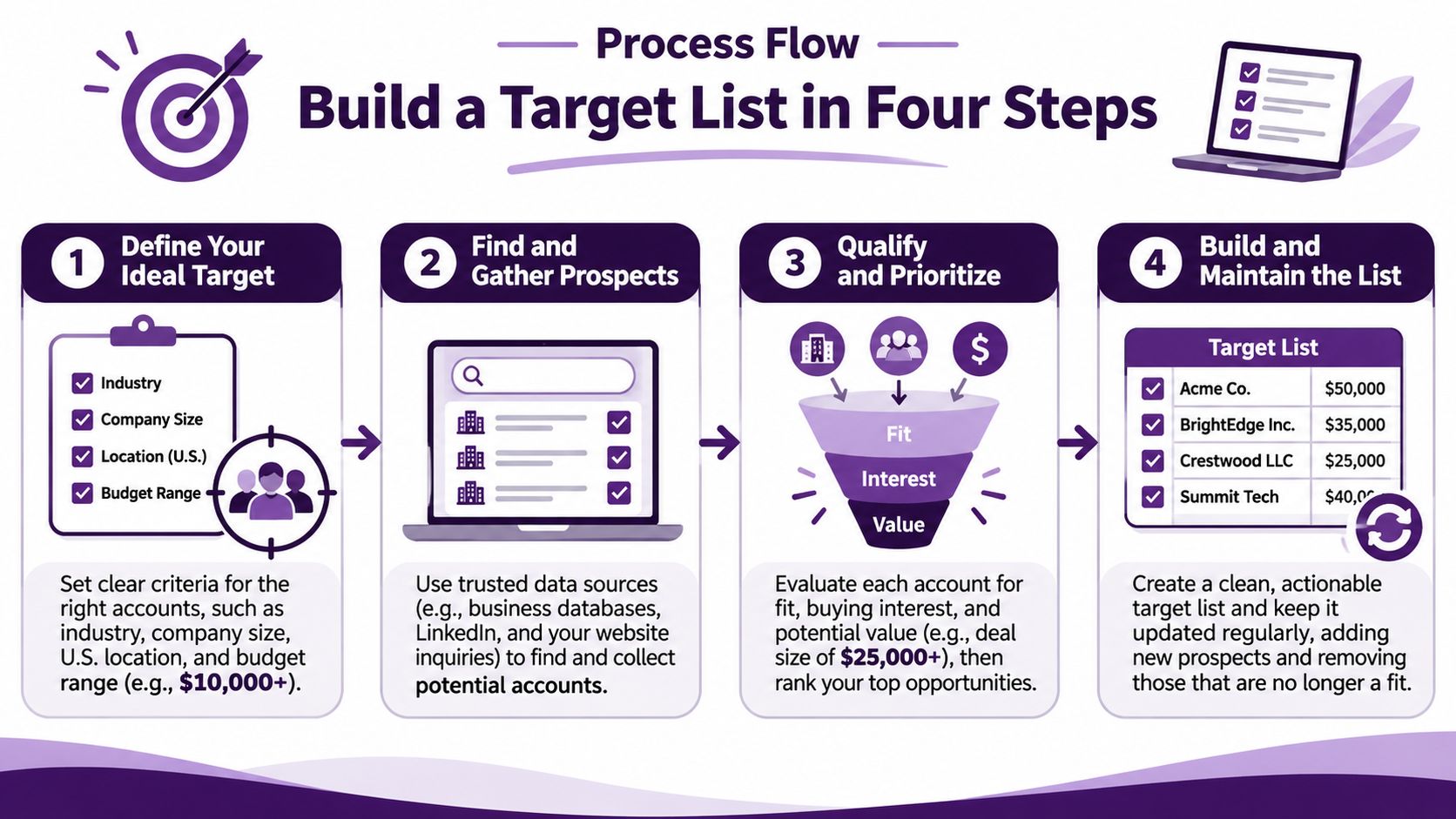
Set your filters before collecting names. Record stage, sector, geography, check-size compatibility, and whether you need a lead investor or followers. These filters prevent you from spending time with people who like the company but can't participate in the round.
-
Collect candidates from evidence-rich sources. Start with fund portfolio pages, accelerator alumni lists, angel groups, and founder communities, then use X to discover people participating in relevant conversations. In DMpro's Searches section, we find leads by entering the username of an influencer in your niche, such as a competitor or industry leader; those results are research candidates, not permission to send automated DMs.
-
Verify that their investing activity matches your situation. Look for recent investments at your stage, read the announcement, and identify which partner sponsored the deal. Flag direct competitors for closer review instead of assuming that every investment in your category is positive evidence.
-
Rank candidates and preserve your reasoning. Put strong fits with a possible introduction in Tier 1, strong fits without a known connection in Tier 2, and exploratory names in Tier 3. Save the evidence, discovery source, and possible connector beside each name so the next action is obvious.
Keep the list small enough to investigate
Don't collect another page of names while your strongest candidates still lack a reason for inclusion. Good prospect research connects observable evidence to a specific reason for contact.
For a local or service business, Chicago Brandstarters' guide on how to find small business investors is a useful companion to a search that might otherwise become too venture-focused.
Practical rule: If you can't explain the fit without mentioning the investor's fame or follower count, keep researching.
A clean list also helps you notice missing segments. If every candidate comes from the same prominent fund directory, add regional angel groups, specialist communities, and founders building for customers like yours.
Qualify Investors Before You Message Them
An investor can understand your product and still be the wrong partner. You need evidence about both their ability to invest and how they'd behave after the money arrives.
That distinction matters in a difficult fundraising environment: Slush's 2025 Startup Struggle Survey found that only 18% of founders believed raising funding would be easy, while 57% disagreed. Pressure to close shouldn't replace judgment about alignment.
Run the five checks
- Recent deal evidence: Find an investment at your stage with a compatible check size. Confirm whether the person you're researching made the decision or merely works at the firm.
- Relevant portfolio experience: Look for companies serving comparable customers or using a similar business model. Adjacent experience can be useful without creating a direct competitive conflict.
- A stated investment thesis: Read interviews, posts, and podcast appearances. Note whether their explanation of attractive businesses describes yours.
- Founder references: Identify someone they've backed and ask about difficult periods, communication, and support when plans changed. Speak with founders beyond the references an investor volunteers.
- Conflicts and control: Investigate competitor exposure, board expectations, follow-on capacity, and decision rights. Have counsel explain proposed terms before accepting them.
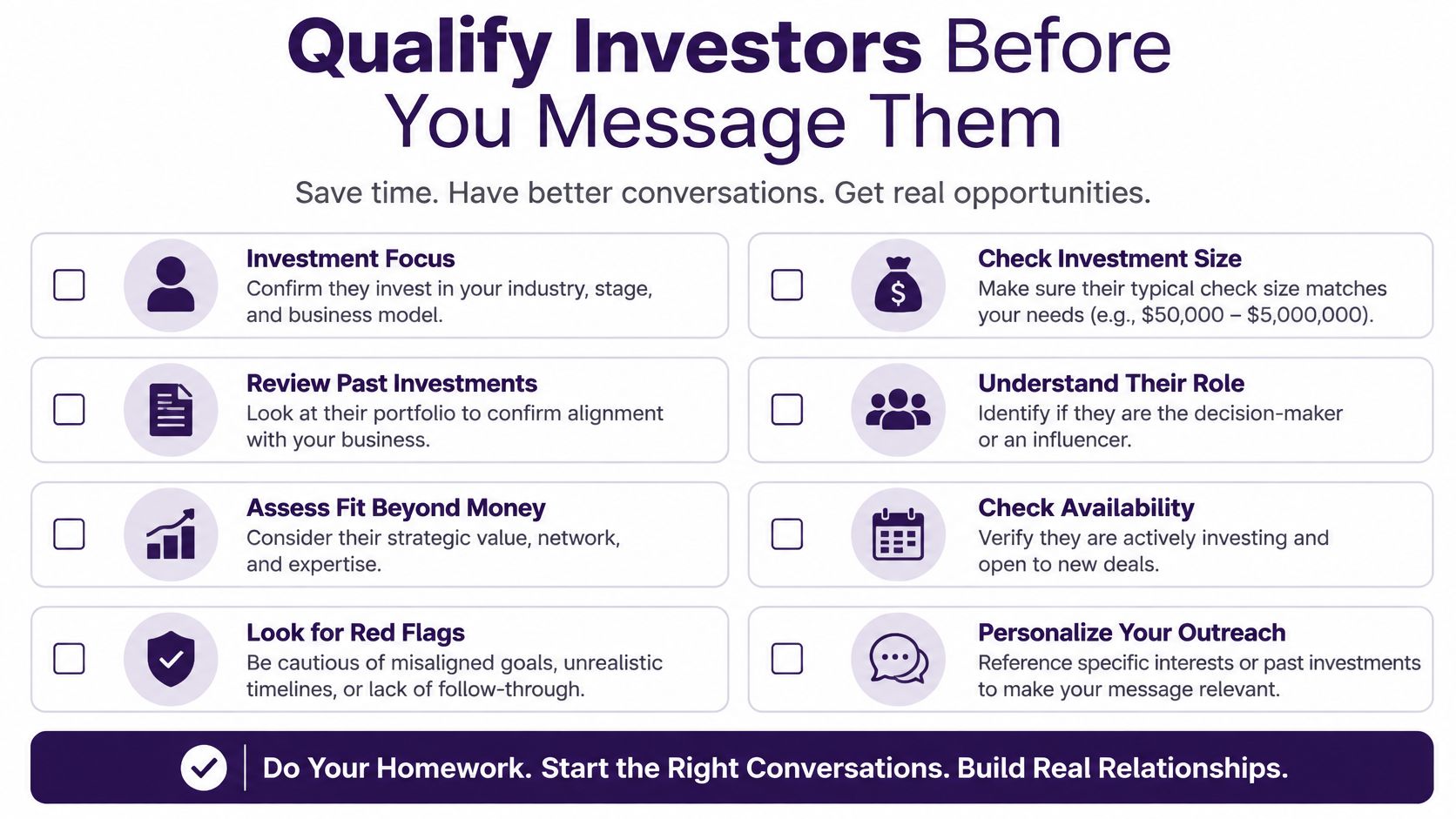
For a practical scoring rule, use three for strong evidence, two for incomplete evidence, and one for weak fit. Reserve personal outreach for candidates passing at least three checks, move low scorers to exploratory status, and let a serious conflict override the total. This is a working filter, not a prediction of who'll invest.
A sound lead qualification process uses profile and conversation evidence. Following an account or replying to a post doesn't establish interest in your offer, and follower counts don't reveal budget or investment intent.
If your financial model needs scrutiny, consider whether support such as Wisely's virtual CFO for growing businesses would help you test runway and financing scenarios. Don't mistake investor enthusiasm for an independent review of your assumptions.
Warm Introductions Beat Cold Messages
Warm paths beat cold messages because a trusted connector can explain why the conversation deserves attention. They don't guarantee investment, but they give the investor context that an unfamiliar name can't provide.
A survey cited in Angel Capital Association guidance attributes approximately 58% of funded deals to professional networks, referrals, or portfolio-company introductions, compared with roughly 10% from cold inbound. Treat cold outreach as a limited experiment, not the foundation of the round.
Make the introduction easy to forward
Map the people who know your best-fit investors: founders, advisers, customers, accelerator mentors, and other investors. Choose the connector with the strongest relationship, not the biggest job title.
Send a short paragraph they can forward without rewriting. For a hypothetical invoicing startup, it could read:
Acme helps freelance design teams send invoices and collect payments. Paying customers are renewing, and we're raising a seed round to expand our agency distribution channel. Your investments in small-business workflow tools make this look relevant. Would you be open to an introduction?
The connector should be able to explain the company, evidence, round, and fit from that paragraph alone. Don't attach a large deck by default; offer supporting materials when the investor agrees to engage.
Make it easy for the connector to decline, too. A reluctant introduction can be less useful than an honest explanation that the investor isn't actively investing.
Build a path when you don't have one
Without an established network, start with public evidence of your competence. Share useful observations about your customers, explain a distribution experiment, or contribute a thoughtful answer to an investor's question on X.
Then approach portfolio founders with a genuine question about their experience. Ask about working relationships, not for an immediate introduction or an endorsement they can't give.
Learning how to network effectively means creating a reason for someone to remember and trust you. Repeated generic compliments don't do that.
Founders without elite credentials can make the conversation concrete through paid pilots, retention, customer references, and domain expertise. Public engagement won't erase unequal access, but it gives you a way to demonstrate judgment before asking someone to risk their reputation on an introduction.
Send Outreach That Gets Replies
Start with a small audience you can review closely. Check the recipient profiles, message wording, and sending account before expanding the campaign; a targeting mistake becomes harder to fix after it reaches your entire list.
Your first message should make replying easy, not attempt to complete the pitch.
- Why this investor: Refer to a relevant investment, stated thesis, or specific conversation.
- What you've proved: Explain the product and give a concise, supportable traction signal.
- One clear ask: Ask whether they'd review a short deck or consider an introductory conversation.
For a hypothetical SaaS founder, that might sound like this:
Your interest in software for independent agencies caught my attention. We're building a client-reporting tool for that audience, and paying teams are using it in their recurring reporting workflow. Would you be open to a short overview of our round?
Replace general traction language with your actual evidence before sending. Don't imply a referral, customer relationship, or familiarity you don't have.

Get permission before automating X messages
X's automation rules prohibit unsolicited bulk or automated DMs and permit automated contact only when recipients have requested it or clearly indicated on X that they want contact. The rules also require an easy opt-out that you honor promptly; a follow, open DM setting, or existing conversation doesn't itself establish consent.
For cold prospects, prefer an appropriate email address or a warm introduction, and respect applicable outreach rules. Don't move an unresponsive person between channels just to keep pursuing them.
Keep the permission record alongside the contact. An explicit request to send fundraising information is useful evidence; a like on a product update isn't.
Good personalized outreach at scale preserves relevance and recipient choice. Automation should execute a reviewed workflow, not decide that everyone near your niche wants a pitch.
A follow-up should make the decision easier, not make ignoring you harder.
As a working cadence, wait about a week before a brief follow-up and stop after two unanswered follow-ups. End sooner after a refusal or opt-out, and pause the sequence whenever a real conversation begins.
Track Replies and Plan for Realistic Volume
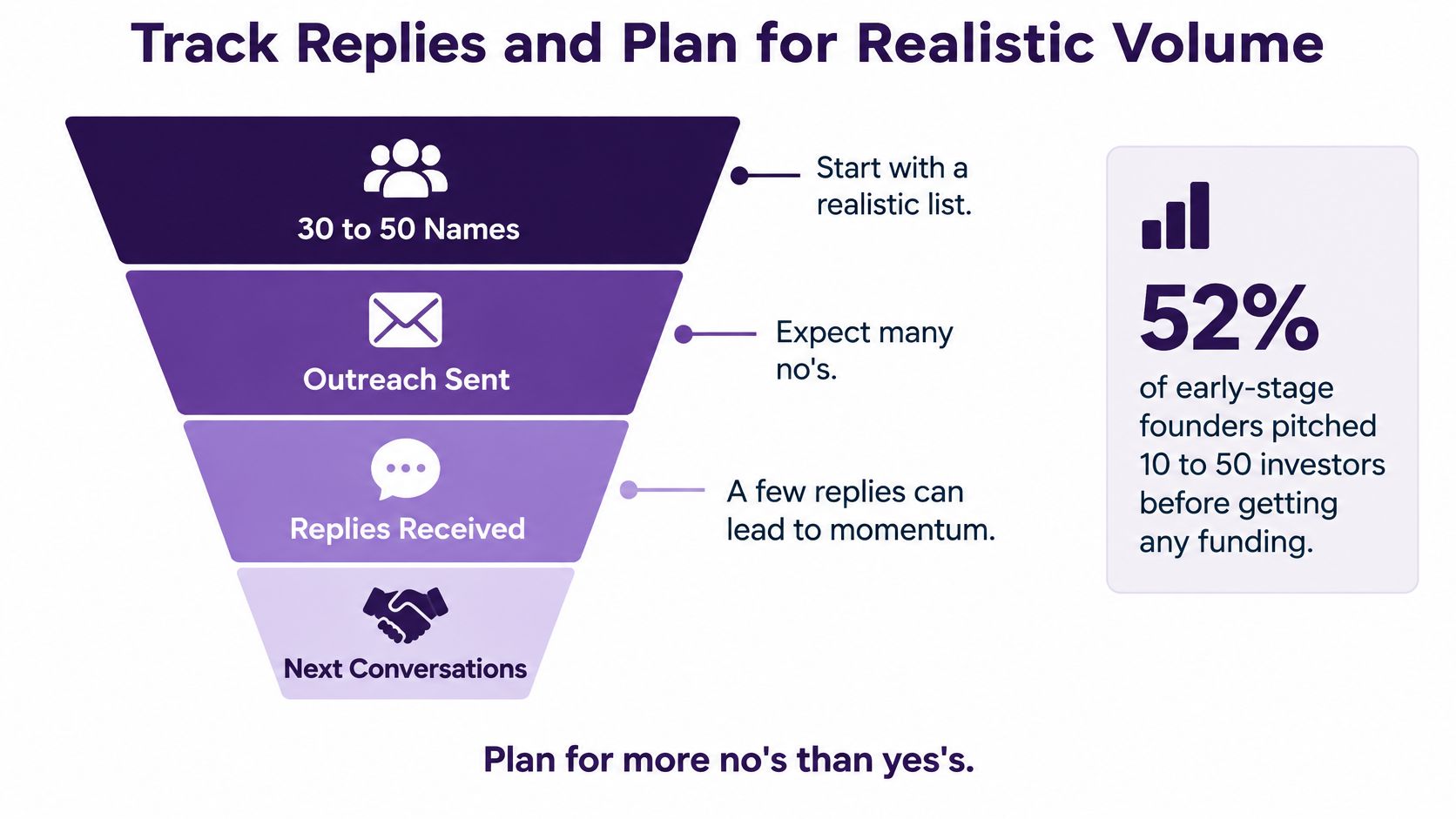
In 2024, 52% of early-stage founders surveyed by HubSpot pitched 10–50 investors before receiving any funding, according to HubSpot for Startups. That makes a working list of 30 to 50 qualified names a reasonable planning exercise, not a promise that a particular number of pitches will close your round.
Plan for more no's than yes's. Also distinguish a rejection from a conversation that hasn't reached a decision.
Investor pipeline stages and what to track
Keep one spreadsheet or CRM, such as Airtable or HubSpot. Give each investor a row with thesis fit, relationship owner, last touch, response, meeting stage, objections, and next action, plus the discovery source.
| Stage | What to record | Common stall sign |
|---|---|---|
| Introduction requested | Date, connector, and the paragraph sent | Connector never replies |
| Introduction made | Date the introduction went out | No response by your planned follow-up date |
| First meeting | Thesis fit score and questions asked | Interest with no next step |
| Diligence | Documents requested and days taken | Long silence after data-room access |
| Term sheet | Terms offered and objections raised | Terms that conflict with your plan |
| Close | Amount, lead investor, and follow-on notes | Unsigned documents or funds not received |
Fix the bottleneck before adding volume
Review the tracker weekly and group outcomes by source. Count introduction requests, completed introductions, meetings, diligence processes, term sheets, and closes without merging them into a single positive-response metric.
If connectors don't forward your note, inspect the connector choice and explanation of fit. If introductions happen but meetings don't, your opening may be unclear, or the recipient may not be investing.
If meetings happen without diligence, review the objections. Investors might understand the product but remain unconvinced about retention, customer acquisition, market size, or the milestone your round will finance.
Don't treat every stall as a copywriting problem. Better wording won't solve an incompatible stage mandate or a business model that doesn't fit venture returns.
Set a housekeeping rule for dormant records, such as marking an unanswered conversation closed for now after three weeks. Preserve the reason and any agreed recontact trigger so a silent prospect doesn't remain an imaginary part of your financing plan.
Your First Week of Investor Outreach
Your first week should produce a usable process, not a rushed term sheet. Work through a bounded set of tasks so research doesn't become an excuse to avoid conversations.
A practical working schedule
- Day 1, establish the workspace. Create the tracker with the seven operating fields and add discovery source beside them. Put a Friday review on your calendar, then write the financing thesis at the top of the sheet.
- Day 2, investigate the shortlist. As a manageable starting exercise, choose ten names across Tier 1 and Tier 2 and apply the qualification checks. Remove weak fits rather than keeping them to make the list look substantial.
- Day 3, activate the strongest paths. Email two or three credible connectors with personalized, forwardable paragraphs. Each request should explain why that particular investor belongs in the conversation.
- Day 4, prepare direct contact. Write personal messages for the next suitable candidates. Use appropriate email outreach for cold prospects and reserve automated X DMs for people with documented permission.
- Day 5, record and schedule. Log replies, assign a next action to every active conversation, and set reminders for follow-ups. Remove anyone who declines or asks not to be contacted.
Review what actually moved
On Friday, count completed introductions and substantive conversations rather than congratulating yourself on messages sent. Note which discovery sources produced people who understood the business and could plausibly invest.
Carry the strongest source into the next week's plan. If no conversations started, review the fit and request before expanding the audience.
A clean list, credible introduction requests, and an honest review habit are useful progress. They give you a fundraising process you can improve without turning investor discovery into indiscriminate messaging.
DMpro offers prospect discovery, personalized messages, and reply-based follow-up workflows to help organize investor outreach on X. Visit DMpro to try automating cold-DM workflows only for people who've explicitly opted in, while you focus on qualification and the conversations that matter.
Ready to Automate Your Twitter Outreach?
Start sending personalized DMs at scale and grow your business on autopilot.
Get started