
Personalized Outreach at Scale That Actually Gets Replies
Learn how personalized outreach at scale works, what to track, and how to automate safely without sounding robotic. Founder-to-founder guide.
You start with hustle.
You open X, pull a list of prospects, read profiles one by one, send a few thoughtful DMs, and get a handful of real replies. It feels promising because it is. Then you try to scale it. The moment you push volume, quality drops, replies slow down, and your messages start sounding like everyone else's.
That's the wall most founders hit.
The problem usually isn't that personalized outreach stops working. The problem is that manual outreach doesn't scale, and shallow automation doesn't stay personal. If all you do is add a first name, company name, and a canned opener, you're not really personalizing. You're just decorating a template.
On X, this gets exposed fast. People can smell fake relevance in one line. They know when a DM was written for “a segment” instead of for them. And once your messages feel synthetic, even a decent offer gets ignored.
I learned to think about this differently. Personalized outreach at scale is not a volume problem first. It's a signal-quality problem. The teams that keep reply rates healthy don't just send more messages. They get better at choosing what to reference, when to reach out, and how much context to include.
If you're trying to build SaaS distribution through X, that shift matters. It changes the workflow, the tooling, and the way you measure success. It also keeps you from burning accounts by pushing automation without guardrails.
If you want a deeper look at how AI fits into prospecting before you build the outreach layer, this guide to using AI for lead generation is a useful companion.
Introduction Why Manual Outreach Stops Working
You send 15 DMs after dinner.
The first five are sharp. You reference a founder's hiring post, a product launch, a complaint they made in a reply thread. By message nine, the pattern shows. Research gets thinner. The opener turns generic. By message fifteen, you are still “personalizing,” but the signal is weak enough that the recipient can feel the template underneath it.
That is where manual outreach breaks on X.
The problem is not effort. It is signal decay. The more messages you try to push by hand, the harder it gets to keep the reason for outreach specific, timely, and believable. Name and company inserts survive scale. Useful context usually does not.
I learned this the hard way. Reply rates stayed healthy when each DM pointed to a real trigger, like a fresh hiring post, a feature request, a public complaint, or a clear buying motion. Reply rates dropped when the message only borrowed surface details from a profile.
Where manual outreach starts losing
Three things usually fail first.
- Research stops being selective: You keep reading profiles, but you stop filtering for signals that justify outreach now.
- Messages lose timing: The reference may still be “personal,” but it no longer explains why this person should care today.
- Follow-up quality collapses: Once the inbox fills up, good first touches get wasted by weak second and third messages.
That trade-off matters more on X than on email. People post in public, react in public, and build a fast intuition for whether you are responding to a real moment or pasting a dressed-up script.
A practical rule helps here.
If you cannot explain why this prospect should hear from you this week, do not send the DM yet.
That is why brute-force manual outreach stalls even when the offer is solid. The bottleneck is not typing speed. It is your ability to keep finding high-quality triggers and turn them into short, natural messages without cutting corners.
For teams building that motion, this guide to using AI for lead generation is useful background before you set up the outreach layer.
What “stops working” actually means
It rarely fails all at once.
You still get some replies. A few conversations still convert. But the system gets fragile. Volume goes up, relevance goes down, and your account starts producing more noise than signal. That is the ceiling.
On X, scale only works when you protect signal quality. The workflow has to help you spot real triggers, ignore weak ones, and keep automation away from judgment-heavy steps. Otherwise, output increases while reply quality slips.
What Personalized Outreach at Scale Really Means
Using “personalization” too loosely is a common mistake.
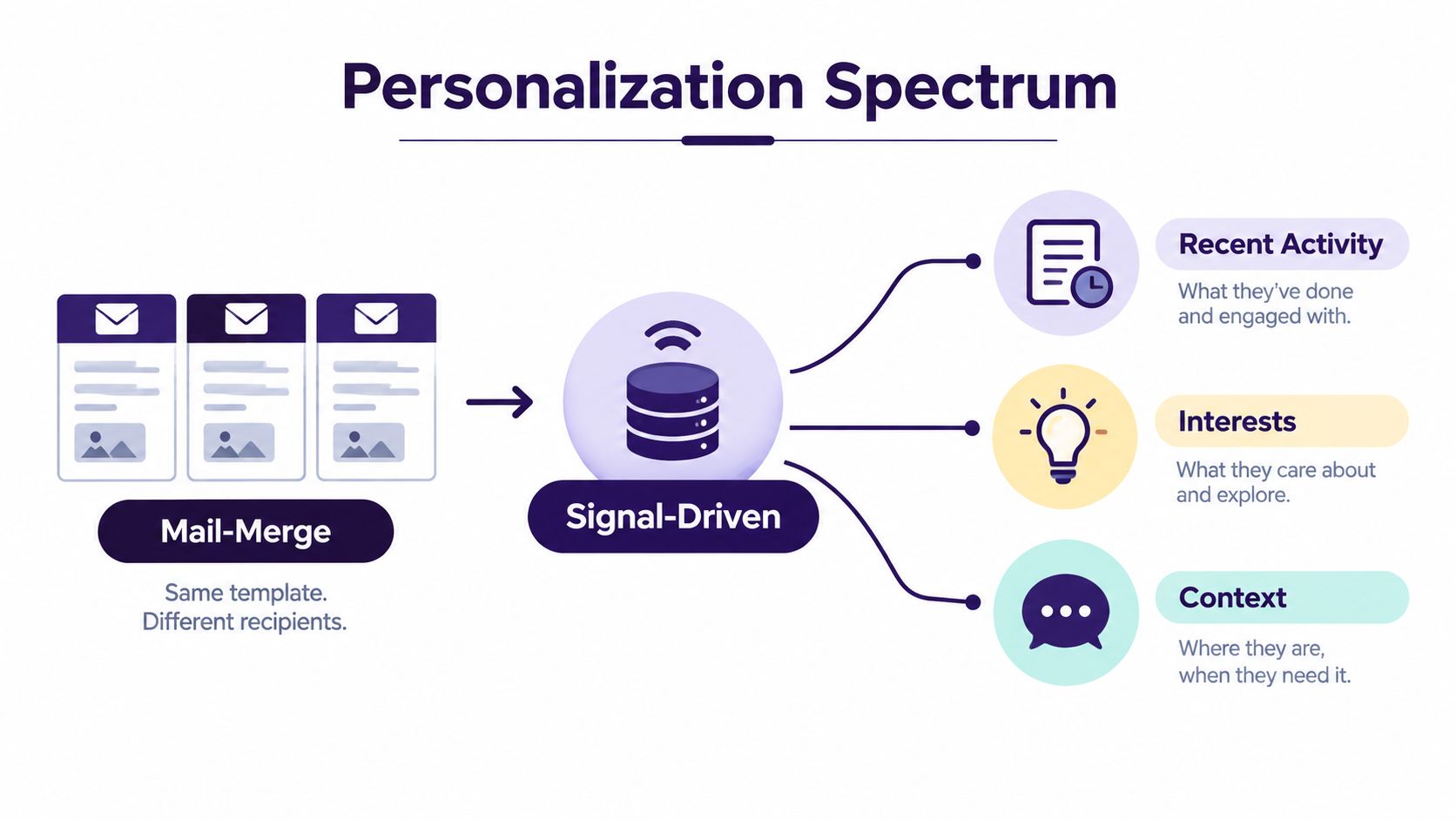
They mean mail-merge. A first name. Maybe a company name. Sometimes a role. That's better than a raw mass blast, but it's still thin. It doesn't tell the recipient why you reached out now.
Real personalized outreach at scale uses signals, not just fields.
The easiest way to think about it
Think of outreach like knocking on doors.
Mail-merge personalization is knocking on every door with the same script, except you read the name on the mailbox first.
Signal-driven personalization is knocking because you saw a real reason to visit that house today. Maybe there's a “for sale” sign. Maybe a contractor truck is outside. Maybe the owner just posted publicly about a problem you solve. The message changes because the context changed.
That's the difference.
A lot of teams still stop at the first layer because it's easy. But the better systems pull in recent activity, visible interests, buyer signals, and timing. That's what makes automation useful instead of obvious.
For teams exploring that shift, DMpro's AI personalization workflow is a practical example of how message assembly can use profile context instead of only static merge fields.
The spectrum from shallow to useful
Here's how I think about the spectrum:
- Template blast: Same message for everyone.
- Basic personalization: Name, company, maybe role.
- Segment personalization: Different copy by persona or niche.
- Signal-driven personalization: Message references recent activity, timing, or a visible trigger.
- Context-aware personalization: Signal plus a relevant interpretation of why it matters.
That last step is what most campaigns miss.
Anyone can reference that a founder posted about hiring. Fewer people can connect that post to a real operational pain point and ask a smart question. That's where replies come from.
Good personalization doesn't prove you found their profile. It proves you understood why now might be the right time to talk.
Why this matters for SaaS distribution
If you're selling a SaaS product through X, you're competing against inbox fatigue and platform skepticism at the same time. People ignore generic DMs because they've seen too many of them.
A scalable system solves that by separating the work into parts:
- data collection
- signal detection
- segmentation
- message generation
- performance review
Once you split the workflow like that, you stop treating outreach as writing. You start treating it as an operating system for relevance.
Benefits and Hidden Costs of Scaling Personalization
A founder sees a post on X about a hiring push, sends a DM that mentions the company name, and wonders why it still gets ignored.
The problem usually is not volume first. It is signal quality.
Personalization at scale works when the message is tied to a trigger that means something right now. A recent launch, a pricing change, a new integration, a hiring pattern, a complaint in the replies, a shift in positioning. Those signals consistently beat name and company inserts because they answer the question every recipient asks in the first few seconds: why are you messaging me now?
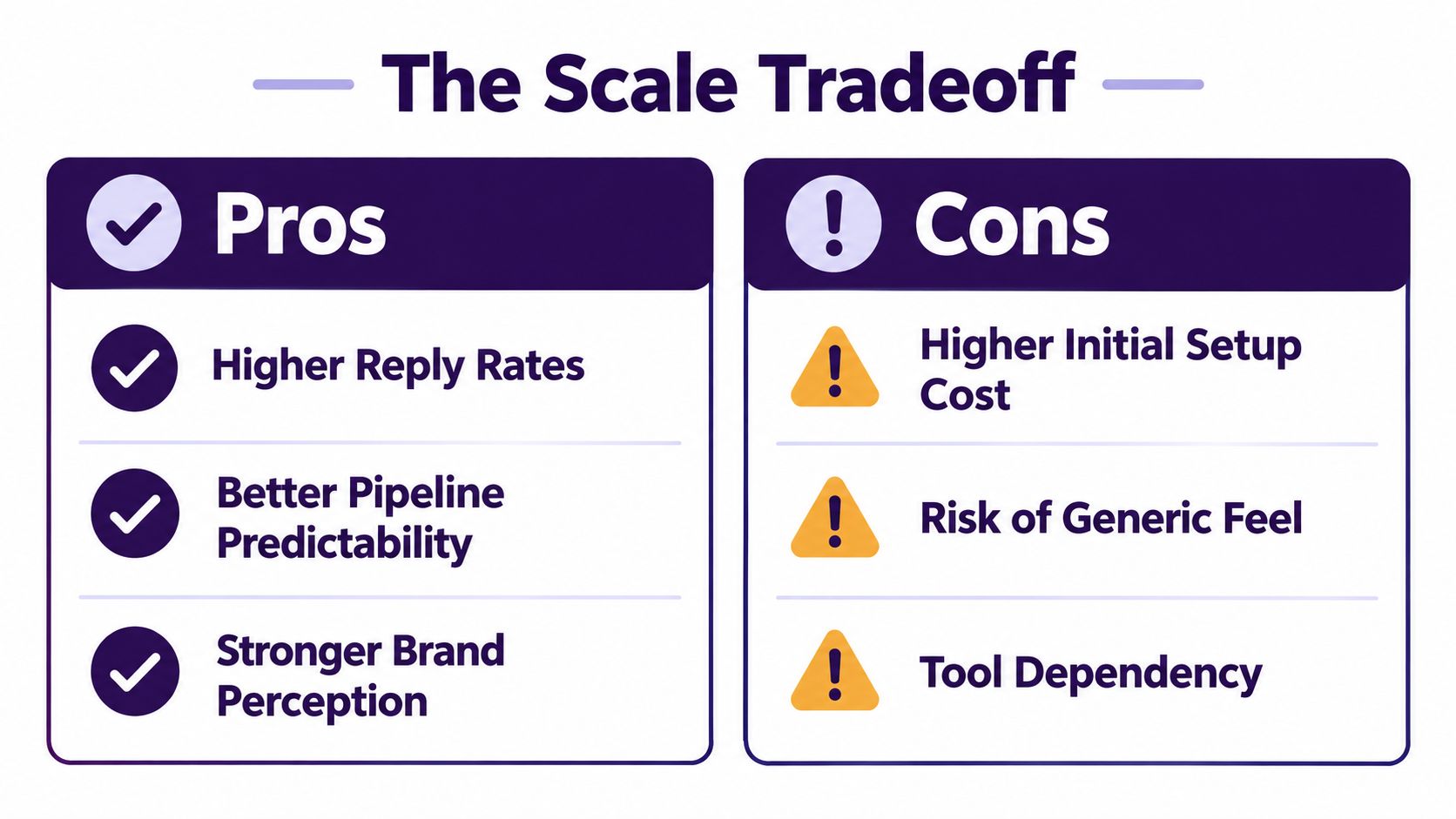
The upside is real. One analysis found that generic templates produced about 9% response rates, basic personalization reached about 11%, and advanced personalization using context and behavioral signals increased responses to about 18%, which it described as 142% more replies than non-personalized outreach in Record Context's breakdown of personalization at scale.
Another useful benchmark from Saleshandy's cold email personalization guide points in the same direction. The more specific the context, the better the odds of a reply.
That does not mean every extra layer of personalization is worth the effort.
I've seen teams spend hours generating one-line “custom” openers pulled from bios, old tweets, or company descriptions that had no buying signal behind them. The copy looked personal. The recipient still had no reason to care. That is the hidden cost of shallow personalization at scale. You add labor, tool spend, and review time without improving relevance.
The second hidden cost is safety on X. Weak signals push teams toward scraping more data, automating faster, and sending messages before the context is verified. That creates a bad mix: lower reply rates, more repeated patterns, and a higher chance your outreach starts to look automated to both users and the platform.
A simple rule helps here. Only scale triggers you would trust a human rep to use manually.
Good triggers usually have three traits:
- Recent: something that happened now, not six months ago
- Visible: something the recipient publicly said or did
- Actionable: something you can connect to a concrete problem, not just a fact
Bad triggers fail on at least one of those. “Saw you're the founder” is obvious. “Noticed you're hiring support reps after a spike in complaint replies” gives you something real to work with.
There is also an organizational cost. Once a team starts treating all personalization as equal, reporting gets noisy. Strong trigger-based messages get mixed with weak merge-field messages, and nobody can tell whether the research layer is helping or just creating more work.
The same pattern shows up outside outbound. Sift AI's empathy scaling guide makes the point well. Systems can scale communication. They do not automatically scale understanding.
The practical takeaway is simple. Fewer high-quality signals beat more “personalized” lines. On X, safe scale comes from selecting triggers carefully, checking them before send, and resisting the urge to automate every message that can be generated.
KPIs That Prove Your Personalization Is Working
A campaign can look productive on paper and still be weak in the inbox.
I've seen teams increase sends, add first names, mention the company, and call it personalization. Then reply rates stay flat. The problem usually is not volume. It is signal quality. If the message was built on a weak trigger, scale just spreads weak relevance faster.
The first metrics to watch
Start with three numbers:
- First-touch reply rate
- Positive-response rate
- Reply rate by personalization tier and trigger type
The third metric is where the truth shows up. A message tied to a recent post, hiring move, or launch should outperform a message that only swaps in a name and company. If both perform about the same, your research layer is adding effort without adding relevance.
I also like checking those numbers against broader DM response rate benchmarks for outreach campaigns. Not as a promise. As a sanity check.
A useful workflow example from Message CEO's breakdown of personalization operations is to track performance by tier, then compare outcomes by trigger category instead of reviewing all personalized messages as one bucket.
Reply Rate by Personalization Depth
| Personalization Level | Typical Reply Pattern on X | What It Usually Includes |
|---|---|---|
| Generic outbound | Lowest and least stable | Broad template with little or no recipient-specific context |
| Basic personalized | Better than generic when segmentation is tight | Role, niche, company, or persona-specific context |
| Trigger-based personalized | Highest when the trigger is recent and visible | Recent post, hiring activity, launch, partnership, product update, or other timely public signal |
The point of this table is not the label. It is the trigger behind the message.
On X, basic personalization can still feel automated because the recipient has seen the pattern before. Trigger-based messages feel different when the context is current, specific, and easy to verify from the profile or feed. That difference usually matters more than writing flair.
A simple measurement setup
Clean tagging beats a complicated dashboard.
Track each outbound message with:
- Tier tag: generic, segmented, signal-driven, or deep context
- Trigger tag: recent post, hiring signal, launch, funding, role change, engagement pattern, or other visible cue
- Outcome tag: no reply, reply, positive reply
Then review the combinations, not just the totals.
If “recent post” and “launch” triggers consistently beat company-name inserts, keep feeding those signals into the system. If “funding” underperforms, that does not always mean the copy is bad. It often means the signal is too broad or too old to create a real reason to respond.
What good performance actually looks like
I care less about whether a campaign hits a universal benchmark and more about whether stronger signals beat weaker ones inside the same motion.
For SaaS outbound more broadly, Firstsales.io's SaaS outbound benchmarks give a rough range for response performance across programs. I would not apply those numbers directly to X DMs. Different channel, different constraints, different user behavior.
The practical read is simpler. If your signal-driven messages are not outperforming generic or basic personalized ones, do not solve that by sending more. Fix the signal selection, the verification step, or the offer. That is the KPI view that keeps personalization honest.
How to Build a Workflow for Personalized Outreach at Scale
A founder pulls a list of 300 accounts, asks a VA to “personalize the DMs,” and gets back 300 messages with first names, company names, and vague compliments. It feels organized. Reply quality says otherwise.
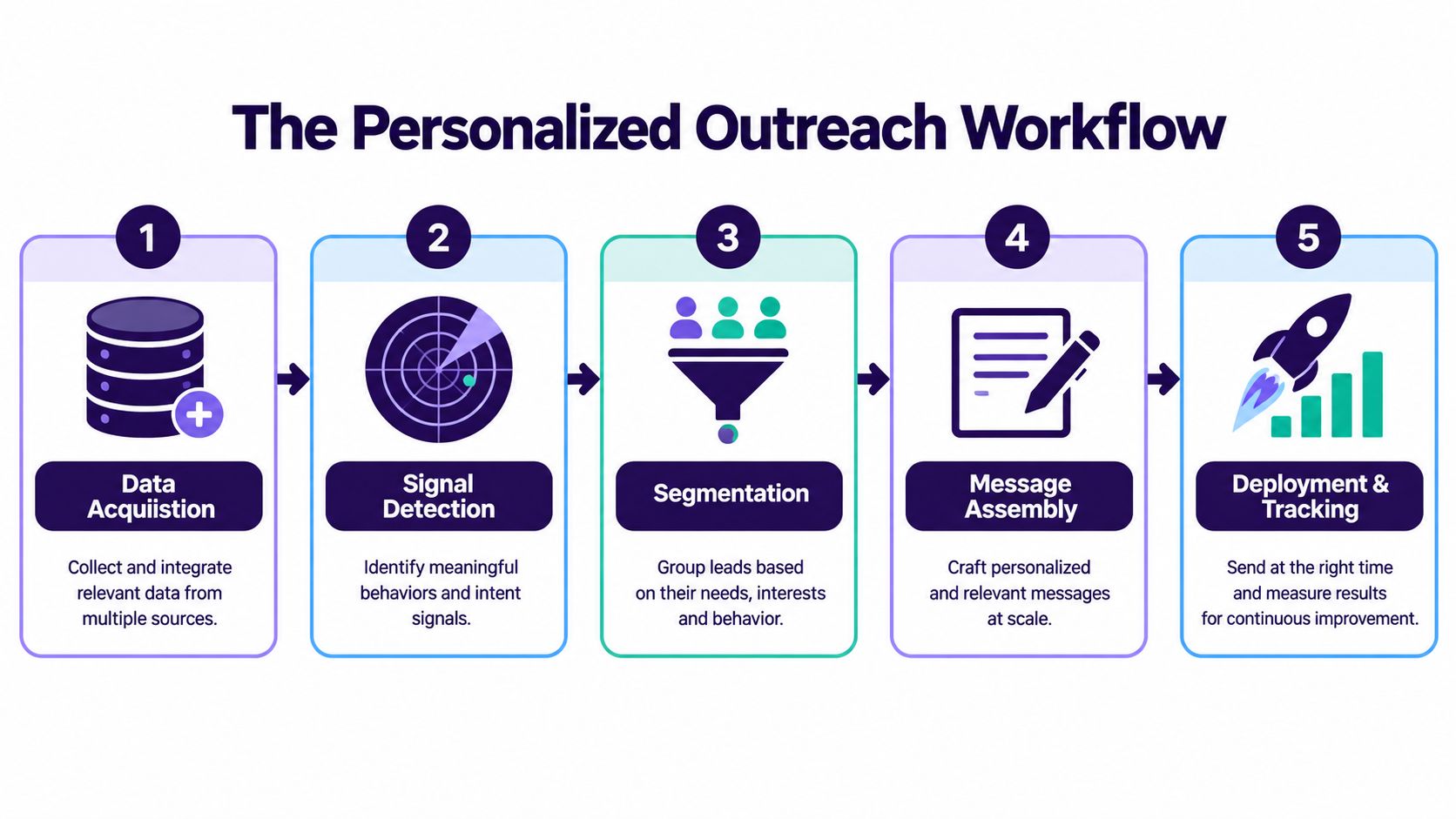
The workflow breaks because the team treats personalization as writing output instead of signal handling. The job is to collect the right cues, verify them, route them to the right level of effort, and only then write.
1. Separate sourcing from signal review
Start with account collection. Then run a second pass that looks only for outreach triggers.
Those are different tasks and should stay different. Sourcing answers, “Is this person in the market we want?” Signal review answers, “Why would this person reply now?”
I use three buckets:
- Static fit: role, niche, company type, geography
- Recent signals: posts, launches, hiring activity, product announcements, engagement patterns
- Disqualifiers: inactive accounts, weak fit, stale triggers, obvious automation bait
This sounds simple, but it fixes a common failure mode on X. A rep sees a good-fit profile, writes a message, then hunts for a detail to make it sound personal. That creates surface-level relevance. The better order is fit first, trigger second, copy last.
If multiple people touch the process, document the handoffs. A short SOP for signal review, message assembly, and QA prevents drift across reps and VAs. workflow standardization for outreach operations is the right frame for that.
2. Score signals before anyone writes
Signal quality matters more than personalization effort.
A recent post with a clear opinion usually beats “noticed you work at X.” A hiring thread often beats “saw your company is growing.” A visible shift in what someone talks about can be more useful than any firmographic field in the CRM.
That changes how the workflow should run. Before drafting, assign each account a simple status:
| Status | What it means | Action |
|---|---|---|
| Write now | Fresh signal with a clear angle | Queue for custom opener |
| Hold | Good fit, weak or old signal | Wait for a better trigger |
| Skip | No fit, no signal, or risky account | Do not message |
This is the part teams rush past. They assume scale means writing faster. In practice, scale comes from filtering better. Fewer bad sends protect reply rates and account health.
3. Define who owns each step
Personalized outreach gets messy when one person does everything and no one owns quality checks.
A cleaner setup looks like this:
- Lead ops or VA: collects accounts and fills static fields
- Research pass: finds one usable trigger and tags it
- Copy owner: writes only from approved tags and source notes
- QA pass: checks whether the opener matches a real, current signal
- Campaign owner: approves pacing, launch windows, and review cadence
On a small team, one person may hold two or three of these roles. The point is not headcount. The point is clear responsibility. If reply quality drops, you should know whether the problem came from sourcing, signal selection, copy, or send behavior.
4. Build messages from verified fields, not freeform prompts
The safest workflow on X uses structured inputs.
Give the writer or the prompt a few locked fields: recent signal, why it matters, offer angle, and CTA type. That keeps the message grounded in something observable and reduces the chance of made-up details.
A simple message structure works well:
- One concrete signal
- One short takeaway
- One low-friction question
That is enough for most outbound DMs on X.
You can watch a practical walkthrough here before building your own version:
<iframe width="100%" style="aspect-ratio: 16 / 9;" src="https://www.youtube.com/embed/kd3K3PGZDII" frameborder="0" allow="autoplay; encrypted-media" allowfullscreen></iframe>The QA standard matters here. Reject any opener that could have been sent without seeing the account. Reject anything based on an old post unless the timing still makes sense. Reject generic praise. “Loved your content” is filler, not context.
5. Close the loop by trigger, handoff, and failure reason
Campaign review should tell you where the process broke.
Review replies by trigger type, but also by workflow stage. Did the researcher pick weak signals? Did the copy owner overinterpret them? Did QA let stale references through? Did the campaign owner push volume on low-confidence leads?
That level of review is how you improve the system without repeating the same mistakes. It also helps you spot a useful trade-off early. Some triggers produce fewer opportunities but much stronger conversations. Others create decent reply volume and poor fit. Both patterns matter.
If you want to connect sourcing, tagging, approvals, and sends without building a fragile stack, PostPulse's guide to social media automation with n8n is useful for wiring the pieces together while keeping the logic visible.
The goal is a workflow that protects signal quality all the way through. That is what makes personalization scale on X without turning into noise.
Choosing Automation Tools and Staying Safe on X
A founder pulls a list of 300 accounts, connects an automation tool, and starts sending. By day two, the account looks active but the replies are thin. By day three, the messages start reading like a pattern. Same structure, same pacing, same weak “personalization” based on name and company.
That is usually a signal problem, not a sending problem.
Good tooling helps you act on real triggers at a pace that does not trip obvious risk signals. Bad tooling turns weak context into scaled noise. On X, that difference matters fast.

What to evaluate before you connect an account
Start with the inputs.
If a tool only swaps merge fields, it will produce the exact kind of outreach people ignore on X. The better test is whether it can work from trigger-based signals you would trust in a manual send. Recent posts. A product launch. Hiring activity that matches your offer. A thread that shows a live pain point. Those signals beat “Hi {first_name}, saw you work at {company}” because they show timing, not just identity.
Then look at control. You need pacing controls, account-level limits, rotation that does not create obvious repetition, and a way to review drafts before they go out. You also need visibility into failures. Which account is getting lower reply quality? Which message variant is drifting generic? Which trigger source is producing stale context?
Those are the questions that keep automation useful.
DMpro is one example of a tool built for this workflow. It supports AI-powered cold DMs on X, profile scanning, outreach based on visible profile context, multi-account management, message rotation, health monitoring, and safety controls. DMpro also reports platform-level outcomes on its site, including lead volume and response-rate ranges. I would treat those as vendor-reported numbers, not planning assumptions for your own campaign.
Safety on X starts with policy, not with software
Plenty of tools can send. That does not make the campaign safe.
X's automation policy says you may not send unsolicited Direct Messages in bulk or in an automated manner, and automated DMs are only allowed when the recipient has clearly indicated intent to be contacted by DM. X also requires a clear opt-out and prompt handling of opt-out requests.
So the practical standard is stricter than “the tool lets me do it.”
The safest setup uses automation for research support, draft generation, pacing, and QA. It does not use automation to blast cold messages at anyone who loosely fits a persona. If the recipient has not signaled openness to DM, that should shape whether you message at all, not just how fast you send.
The real risk pattern is easy to spot
Accounts get into trouble when teams scale the wrong variable.
They push volume before they prove signal quality. They rely on stale references. They let one winning opener become a template and then overuse it until it becomes obvious. On X, repeated behavior is visible. So is fake familiarity.
A safer operating rule is simple. Send fewer messages per account, use stronger triggers, and kill anything that starts to look templated across a cohort.
Rate limits still matter
X also publishes rate limits for managed DM endpoints in its direct message API documentation. Those limits put a ceiling on how aggressively you can run, even before you get to message quality and policy risk.
The older v1 DM create flow has its own constraint in X's v1 DM create endpoint reference. Once a user receives a message, only a limited number of follow-up messages fit inside that rolling window before rate limiting applies.
That has a few practical consequences:
- Pace sends conservatively
- Honor opt-outs right away
- Limit follow-ups and make each one distinct
- Review message patterns across accounts, not just per campaign
- Use automation to enforce restraint, not to hide bulk behavior
The teams that stay safe on X usually do one thing well. They treat automation as a control system for signal quality, approval, and pacing. Not as a shortcut around relevance.
Putting It All Together and Your Next Campaign
The biggest shift is simple.
Personalized outreach at scale works when signal quality stays high. It breaks when you confuse activity with relevance. More messages won't save weak timing, weak triggers, or weak copy.
So if you're launching a campaign this week, keep it narrow.
A clean starter plan
-
Choose one audience Pick one clear SaaS segment or buyer type on X.
-
Choose two or three visible signals Recent posting activity, hiring, launches, or specific interests are enough to start.
-
Track the right outcomes Watch first-touch reply rate, positive-response rate, and performance by signal type.
That's enough to learn fast without building a giant outbound machine on day one.
If you want help thinking in tighter account clusters instead of broad lists, CapyScout ABM campaigns guide is worth your time. It lines up well with the same idea here. Better targeting makes better personalization possible.
The goal isn't to sound clever. It's to sound timely, relevant, and worth answering.
If you're tired of manually researching profiles and sending cold DMs one by one, DMpro gives you a way to automate outreach on X with personalization tied to real profile context, message rotation, and safety controls. It's a practical fit when you want more conversations without turning your outbound into obvious spam.
Ready to Automate Your Twitter Outreach?
Start sending personalized DMs at scale and grow your business on autopilot.
Get Started Free