What Is Conversion Optimization: The Founder's Guide
Learn what is conversion optimization and how to turn existing traffic into revenue. A practical CRO guide for SaaS founders and growth marketers.
You're probably living this already.
Traffic is up. You're shipping content, buying clicks, posting on X, maybe even running outbound every day. But revenue feels stuck. The dashboard looks busy, your team feels busy, and still the business doesn't get easier.
That's usually the moment founders ask a better question. Not “how do I get more visitors?” but what is conversion optimization, really, and where is my funnel leaking?
Most guides reduce CRO to button colors and tiny page tweaks. That's too small. In practice, conversion optimization is a system for getting more revenue from the traffic and conversations you already paid to create. That includes your website, your signup flow, your pricing page, and yes, your outbound DMs too.
Why Traffic Alone Won't Save Your Startup
A founder buys more traffic, sees sessions climb, and still ends the month arguing about why revenue barely moved. I've been in that spot. The click came in, but the path after the click was weak.
A lot of startups die with decent traffic. Acquisition keeps running while the handoff to action stays fuzzy. People land, scan, hesitate, and leave. Prospects open an outbound message, show a little interest, then disappear because the next step feels generic or risky.
That is why what is conversion optimization matters. It is the work of increasing the share of people who take a meaningful action, whether that is a purchase, a demo request, a signup, or a reply. Good CRO is not about gimmicks. It is about making the path clear enough for the right buyer to keep going.

Benchmarks show the gap is real
The average conversion rate across industries sits around 2.9%, with e-commerce at about 2.7%, according to DemandSage CRO benchmarks. That matters because paid traffic keeps getting more expensive. If only a small slice of visitors converts, buying more clicks often just buys more waste.
Analysts at SearchLab's conversion optimization statistics put the median conversion rate across industries at about 2.35%, while top-performing pages reach 11.45% or higher. Founders do not need perfect traffic before fixing this gap. They need a tighter path from interest to action.
Practical rule: If you have not audited the conversion path, more traffic usually scales waste faster than revenue.
More visitors do not fix a weak journey
A weak journey hides everywhere.
It shows up on the landing page when the headline is broad and the CTA asks for too much too soon. It shows up in signup flows that create work before the user sees value. It shows up in outbound too, which many CRO guides ignore. If someone replies to a DM and gets sent to a generic homepage, the problem is not volume. The problem is message match.
I learned that one the expensive way. We kept trying to improve campaigns at the top of funnel when the issue was the handoff between channel and destination. Paid click to homepage. Cold DM to generic calendar link. Good intent, bad path.
Lead quality usually exposes this faster than raw traffic numbers do. This guide on how to improve lead quality is useful for that reason. It forces a harder question: are you attracting the right people, and does the next step fit what they expected?
The founder view of CRO
CRO matters most when cash is tight and every acquired visit has a cost behind it.
It turns the same spend into more demos, more qualified replies, and more paid users. It also changes how the team works. Debates get shorter. The conversation moves from opinions to friction points, drop-offs, and whether the next step is clear on both the website and in outbound flows.
Growth stops looking like a traffic shortage. It starts looking like a system you can fix.
The Core Metrics That Actually Matter
Clicks, impressions, and open rates fill dashboards quickly. They also rarely predict whether the business is improving.
I care about three numbers first: conversion rate, CAC, and LTV. Together, they show whether paid traffic and outbound effort are turning into revenue, or just producing busy reports.
Start with conversion rate
Conversion rate answers a simple question. After someone lands on a page, clicks an ad, or replies to a DM, do they take the next action you want?
That action changes by stage, so I break conversions into three groups:
- Primary conversions. Actions tied closest to revenue, like a paid signup or a booked demo.
- Micro-conversions. Smaller signs of intent, like visiting pricing, starting a form, or replying to a DM.
- Diagnostic metrics. Clues that explain friction, such as drop-off points, weak message match, or low completion rates on a specific step.
Teams often celebrate the wrong win. A landing page can lift form starts while booked meetings stay flat. A DM sequence can increase replies while qualified conversations fall. Good CRO work tracks the handoff all the way through the funnel, including outbound. Infuse's conversion optimization glossary does a good job framing that broader view.
Then check unit economics
A higher conversion rate only helps if the economics still work.
CAC shows what it costs to get a customer. LTV shows what that customer is worth over time. Put those beside conversion rate and the trade-offs get clearer. I have seen campaigns with strong signup rates fail because the leads were poor fits, the sales cycle dragged, or retention never showed up.
That is why I review CRO alongside pipeline health. Website performance, paid traffic, and outbound replies all feed the same revenue system. Eludic's B2B sales pipeline metrics guide is useful here because it connects front-end conversion activity to what happens later in sales.
A conversion that doesn't lead to durable revenue is a misleading win.
What founders should measure weekly
Keep the scorecard short enough to use every week.
- Conversion rate by step. Measure the actual path, such as visit to signup, signup to demo, demo to customer, or DM sent to reply.
- Customer acquisition cost. Watch where paid channels or outbound workflows stop producing efficient growth.
- Customer value. Even a directional LTV estimate is enough to catch bad optimization decisions early.
- Segment performance. Separate branded traffic, cold traffic, partner traffic, and outbound traffic. Their baselines are different.
- Qualified conversion rate. Count how many conversions match your ICP, not just how many happened.
For a tighter operating view, this guide to lead generation metrics that connect activity to pipeline is a useful companion.
A Practical CRO Framework for Founders
CRO gets messy when teams run random tests with no system behind them. One person changes the headline. Someone else shortens the form. Sales rewrites the CTA. A week later nobody knows what caused what.
Founders need a workflow, not a bag of tactics.
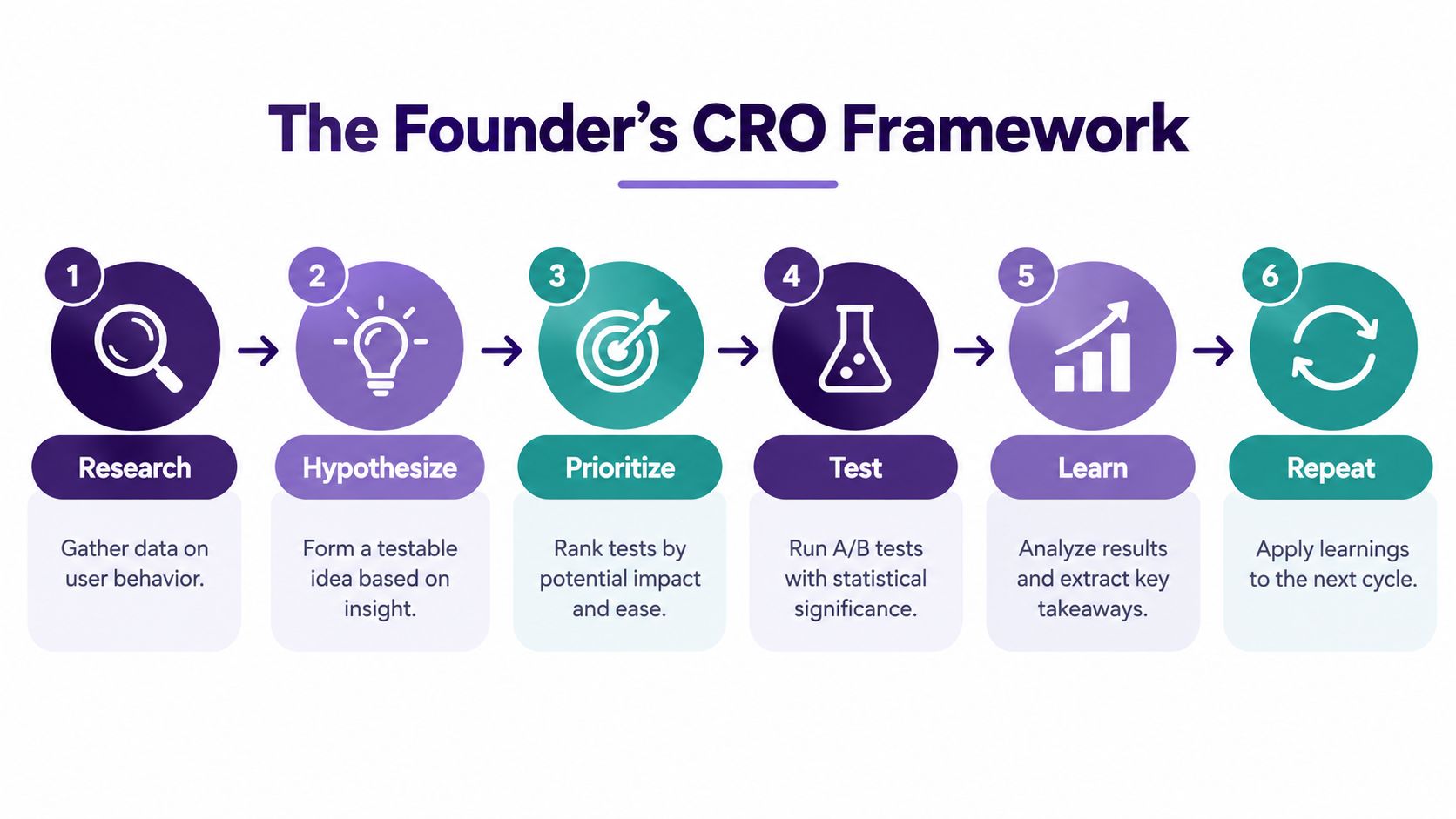
The six steps that keep CRO grounded
Here's the operating model I trust:
-
Research
Look at behavior first. Where do users stall, hesitate, or disappear? On outbound, this might mean low reply quality. On site, it might mean a pricing page that gets visits but no action. -
Hypothesize
Turn the observation into a testable idea. Not “the page feels weak.” Something tighter, like “buyers don't understand the use case fast enough.” -
Prioritize
Rank changes by likely impact and ease. Founders waste time when they polish low-traffic pages instead of fixing the obvious bottleneck. -
Test
Change one meaningful variable or one coherent bundle of changes. Keep the test understandable. -
Learn
Don't just ask whether it won. Ask why. The learning often matters more than the individual result. -
Repeat
CRO compounds because each cycle improves the next one.
The CRO workflow
| Step | Action | Outcome |
|---|---|---|
| Research | Review behavior and drop-off points | Clear view of friction |
| Hypothesize | Write a reasoned test idea | Testable direction |
| Prioritize | Choose highest-impact opportunities | Better use of time |
| Test | Run a controlled experiment | Comparable result |
| Learn | Analyze what changed and why | Reusable insight |
| Repeat | Feed insight into the next cycle | Ongoing improvement |
What works and what wastes time
The biggest mistake is jumping from opinion to redesign.
Founders often say, “Let's refresh the page.” That usually means too many variables changed at once. Now your team has motion, but not clarity. A stronger approach is to test around the actual friction point first. Sometimes the answer is copy. Sometimes it's form design. Sometimes it's that the CTA asks for too much commitment too early.
For teams that want a practical reference on designing cleaner experiments, Figr's guide to A/B testing best practices is useful.
Field note: Good CRO feels slower at the start because you're forcing clarity. It gets faster later because you stop re-learning the same lessons.
One framework across channels
This framework also works outside the website.
If your outbound sequence on X gets opens but no replies, that's a CRO problem. If replies come in but calls don't book, that's also a CRO problem. The surface changes, but the system doesn't. Research the friction, form a hypothesis, test the next step, and keep the loop tight.
Tactics for Web and Outbound Outreach
The mistake is thinking optimization ends at the landing page.
Buyers don't experience your funnel as separate departments. They see one journey. Maybe they click an ad, browse your site, leave, later get a DM on X, check your profile, click back to a page, and decide there whether to reply or book. If those touchpoints don't line up, conversion suffers.
Web fixes that usually matter first
On the website side, I'd start with the blunt issues before touching visuals.

- Clarify the promise. Your headline should tell the buyer what you do, who it's for, and why it matters.
- Trim the ask. Long forms and vague CTAs kill momentum.
- Match message to source. Traffic from paid search, content, and outbound DMs arrives with different intent. Don't dump all of them onto the same generic page.
- Reduce decision fatigue. A page with too many paths often converts worse than a page with one obvious next step.
Another useful benchmark point is how much landing page strategy matters. One dataset reports that companies with 10 to 15 landing pages see a 55% increase in conversions, those with 21 to 40 pages see nearly a 300% increase, and sites with 40+ landing pages can experience more than a 500% boost, according to WiserReview's CRO statistics roundup. The takeaway isn't “make pages for everything.” It's that specificity usually beats one-size-fits-all traffic handling.
Outbound is a conversion channel too
Founders who rely on X for lead generation often miss this. The DM itself is part of CRO.
Message quality matters, but so does sequencing, timing, and the transition from conversation to next step. If your outreach says one thing and your landing page says another, response quality drops. If you ask for a call too fast, buyers stall. If you never guide the conversation forward, good replies die in the inbox.
X also has hard platform constraints. The platform documents a 500 direct message per day account-level cap, and for API sending it lists 1,000 requests per user per 24 hours and 15,000 per app per 24 hours in its official limits documentation. That means scaling outreach is not just a copy problem. It's an operations problem.
When teams automate outreach, pacing matters too. X's API uses windows that are usually 15 minutes or 24 hours, and it returns 429 errors when the rate limit is exceeded, which is why the platform tells developers to check x-rate-limit-reset and use backoff in its rate-limit fundamentals.
If you want to tighten message quality before you scale, this guide on message testing best practices is the right place to start.
A blended funnel works better
The strongest setup is simple. Use the site to convert warm intent and use outbound to create conversations with the right accounts.
That's where a tool like DMpro fits naturally. It automates cold DMs on X, handles personalization and campaign flow, and gives teams a way to treat outbound like a measurable conversion system instead of a manual chore. That matters when you're trying to scale SaaS distribution without adding headcount for every extra campaign.
A quick walkthrough helps more than text here:
<iframe width="100%" style="aspect-ratio: 16 / 9;" src="https://www.youtube.com/embed/kLneJKAqRtk" frameborder="0" allow="autoplay; encrypted-media" allowfullscreen></iframe>One more detail gets overlooked in follow-up design. X's DM endpoint includes a 24-hour conversation rule. Once a user receives a message, you may send up to 5 messages in response within a 24-hour window, and each new received message resets both the time window and the allowance, according to the X DM endpoint reference. That changes how aggressive your follow-ups should be.
Common Pitfalls and How to Avoid Them
Some CRO mistakes reveal themselves quickly. Others persist because they mimic productive work.
A founder launches paid traffic, sees clicks coming in, and starts changing everything at once. New headline. Shorter form. Different CTA. Tweaked pricing section. Then outbound replies dip, site conversions wobble, and nobody can say which change helped or hurt.
I've made that mistake. It feels like momentum. It destroys signal.
Good optimization versus noisy optimization
The difference usually shows up in how teams run tests and how they define a win.
| Weak approach | Strong approach |
|---|---|
| Changes headline, layout, form, and CTA all at once | Tests one friction point at a time |
| Optimizes for signups alone | Optimizes for the step tied closest to revenue |
| Uses one benchmark for every traffic source | Separates by channel, intent, and page type |
| Declares a winner too early | Waits for a stable read before changing course |
Noisy optimization creates activity logs. Good optimization creates decisions.
That matters even more when you run both paid traffic and outbound. A landing page visitor from search behaves differently from someone who clicked through from a DM conversation. If both paths get pushed into the same report, teams often "improve" the funnel by averaging away the problem.
Mobile neglect is expensive
A lot of founders still review their funnel on a laptop and call it done.
That misses where friction usually shows up first. On mobile, weak page speed, awkward forms, and buried CTAs kill intent fast. Paid social traffic is especially unforgiving here, and DM traffic often lands on mobile too because the conversation started in-app.
Treat mobile review like revenue review. Open the page on your phone. Complete the form yourself. Count the taps. Notice where the keyboard covers the CTA. Check whether the page still makes sense halfway down the screen.
Small annoyances add up. Fewer people complete the action. Paid clicks get more expensive. Follow-up volume drops. The team blames targeting when the handoff is the issue.
The wrong goal can poison the whole effort
Another common failure is picking a conversion goal because it is easy to measure.
Signups can mislead. Replies can mislead too. I've seen outbound campaigns generate plenty of responses from cold DMs, while the actual pipeline stayed flat because the message attracted curiosity instead of qualified demand. The same thing happens on-site when a landing page gets more form fills from weaker traffic and sales cannot close any of it.
Use one primary conversion tied to revenue. Then track a few supporting signals that explain why that number moves.
For a SaaS founder, that often means qualified demos booked, activated trials, or opportunities created. Page engagement, click-through rate, form starts, and DM reply rate can still help. They just should not run the strategy.
Channel mismatch wastes good traffic
This one gets ignored because the page and the message are often owned by different people.
If a paid ad promises one pain point and the landing page opens with a different story, conversion drops. If a cold DM starts a conversation around speed or cost and the next page talks like a generic brand deck, buyers hesitate. The problem is not always the traffic source. Often the promise breaks between touchpoints.
Founders should review these assets as one funnel. Ad, DM, landing page, form, follow-up. Same audience. Same problem. Same next step.
That is how CRO stops being a button-color exercise and starts acting like a revenue system.
Your Next Steps for Sustainable Growth
A founder pays for clicks all week, books a few demos, gets a handful of DM replies, and still cannot explain why revenue did not move. That is usually the moment CRO stops feeling like a marketing side task and starts becoming an operating discipline.
Sustainable growth comes from a system you can run every week. You need a clear view of where demand enters, where intent drops, and which change has the highest chance of improving pipeline. That applies to paid traffic, organic traffic, referrals, and outbound on X.
A simple operating checklist
Use the next few days to get the basics in place:
- Choose one primary conversion tied to revenue. Pick the action that signals real buying intent.
- Map the full path. Include ad or DM, landing page, form, reply, and follow-up.
- Name the biggest friction points. Weak offer, slow page, vague CTA, poor qualification, or a broken handoff to sales.
- Run one test with business impact. Start where prospects hesitate before they become pipeline.
- Review performance by segment. Paid search visitors and DM-sourced prospects behave differently, and they fail for different reasons.
- Close the loop each week. Every test should end with a decision, an owner, and the next test.
Treat outbound and on-site as one system
I see teams split these channels too often. Growth owns the landing page. Sales owns outbound. Paid owns the ads. Then each group reports a local win while revenue stays flat.
Buyers experience one journey. The promise in the ad or DM needs to match the page, the form, and the follow-up. That is especially important if you use outbound alongside paid acquisition, because the conversation started in a DM can warm up a buyer before they ever hit the site.
Build a dashboard people will actually use
Keep the reporting tight.
A useful dashboard shows conversion movement, lead quality, reply quality, and drop-off by step. It should help the team decide what to fix next, not impress everyone with chart volume. If your reporting is messy, this guide to analytics dashboard readability and structure is a good place to clean it up.
Conversion optimization compounds when every visit and every conversation is designed to produce revenue. Cosmetic tweaks have their place, but they rarely carry the business on their own. Founders who build sustainable growth treat CRO as a repeatable system. They keep the message, page, follow-up, and outbound motion aligned, then improve the bottleneck that is holding back revenue right now.
If you're using X for outbound, DMpro helps you automate cold DMs, manage reply flows, and treat outreach like a measurable conversion channel instead of a manual task. If you're tired of sending messages one by one and want a cleaner system for turning conversations into pipeline, it's worth trying.
Ready to Automate Your Twitter Outreach?
Start sending personalized DMs at scale and grow your business on autopilot.
Get Started Free